


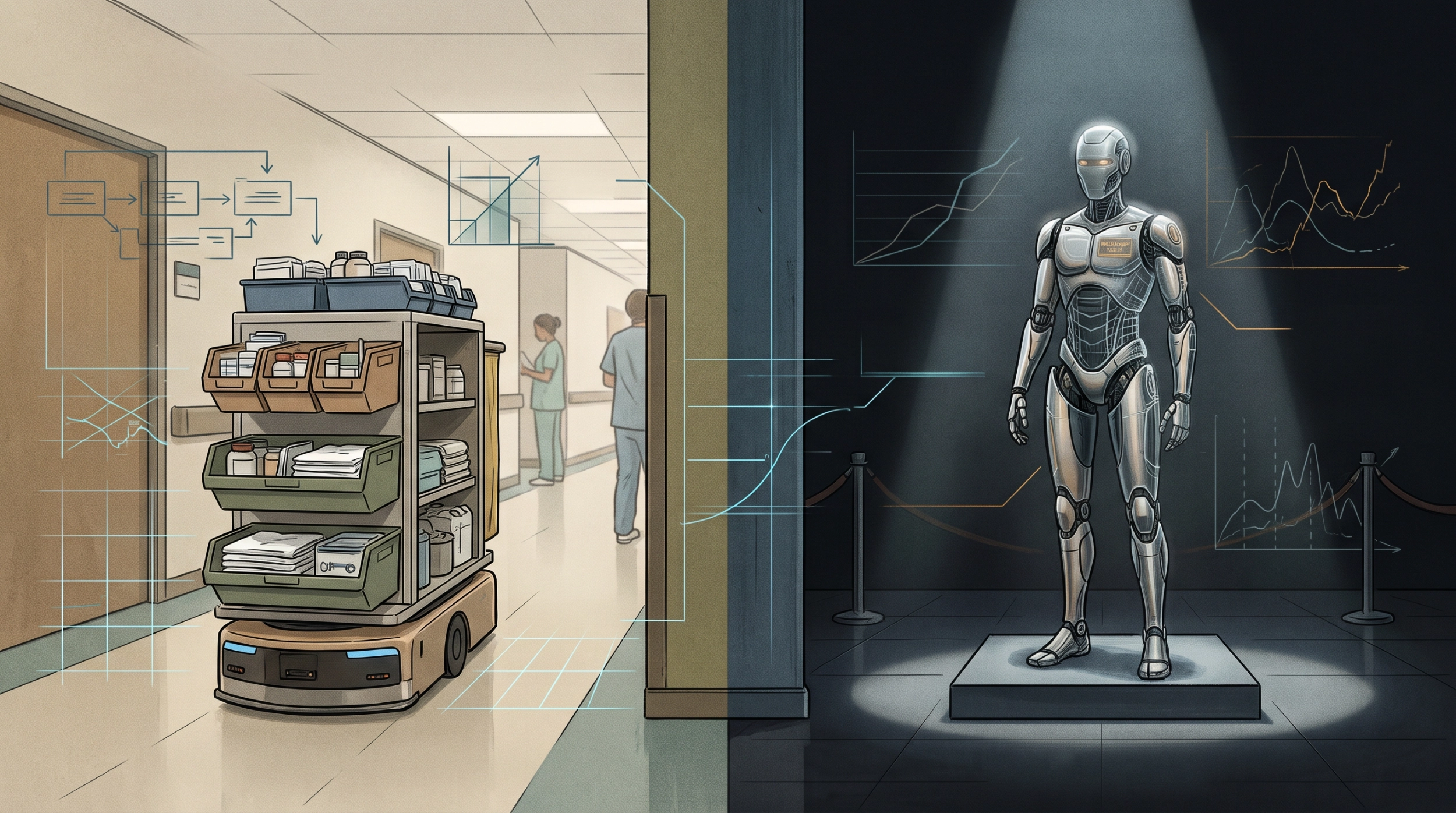
Silicon Valley’s return to hardware is being sold partly as a story about technological progress. Better AI will make machines more capable, automation will reach more industries, and businesses that were previously too difficult to build will become possible. But there is another explanation for the enthusiasm: investors are becoming less certain that software alone will remain defensible.
That distinction stayed with me after my Hard Things conversation with Dave McClure. Are we investing in physical AI because the economics of building useful machines are improving, or because the economics of owning software businesses look less secure? Both can be true, but they lead to very different investment decisions.
Dave makes an unusually useful sparring partner for this question. He is skeptical of hardware’s newfound popularity while actively investing in it. His position is not that the opportunity is imaginary. It is that an exciting category can make people less demanding about the individual businesses inside it.
Difficulty is not the same as defensibility
“Hardware is hard for AI, but that also means it’s hard for you, too,” Dave said. It was the clearest expression of the problem with treating atoms as a refuge from software competition.
A long development cycle may slow competitors, but it also consumes the company’s capital. Manufacturing expertise may become an advantage, but only after the company acquires it. A product that is difficult to replicate is not necessarily a product that can be delivered reliably, at an attractive margin, to enough customers.
The distinction matters because a barrier becomes valuable only when the business can overcome it more effectively than others. Otherwise, the supposed moat is simply an expensive obstacle shared by everyone in the category.
My conclusion is that hardware’s difficulty should raise the standard of underwriting, not lower it. The question is not merely whether a business will be harder for AI to disrupt. It is whether the company can turn its technical and operational capabilities into a customer advantage that justifies the cost of building them.
Start with the job, then choose the machine
When I asked Dave to choose between a general-purpose humanoid with an enormous theoretical market and a boring machine doing one profitable job, he chose the latter. His qualification was that it wasn’t sexy.
That answer points to a useful way of evaluating physical AI: begin with work someone already needs done. What is the task, who pays for it, what does it cost today, and why is the existing solution inadequate? Only then ask what combination of machinery and intelligence can do it better.
We discussed hospital logistics and elder care because the needs are concrete. Moving a patient to a procedure or helping someone in and out of bed does not require inventing demand. It requires delivering a safe, dependable outcome within an existing workflow.
This does not settle the argument against humanoids. Some jobs may genuinely benefit from a machine designed to operate in spaces built for people. But the form factor should follow the application rather than substitute for one.
The broader lesson is that a large theoretical market can conceal a weak initial product. A narrower application gives a company something more useful than a sweeping vision: a customer, a measurable outcome, and a way to learn whether its solution is worth paying for.
The business begins where the demonstration ends
A successful demonstration establishes that a machine can perform a task under particular conditions. A repeatable business requires evidence that it can keep performing that task across the conditions a customer actually encounters.
Dave’s response to the hypothetical founder with two paying pilots was revealing. Either the environments should be similar enough to demonstrate repeatability, or the company should give him a reason to believe it can handle a third, different environment. The number of pilots matters less than what they teach us about the next deployment.
I put more weight on expansion within an existing customer. A pilot can come from an innovation budget, where experimentation is part of the purpose. Expansion into additional sites, funded by an operating budget, suggests the customer is beginning to treat the product as part of how the business runs.
Even that evidence needs an honest accounting of delivery costs. Remote operators, installation engineers, maintenance, and customer support are part of the economics, not inconvenient details to remove from the presentation. Human involvement is not automatically a flaw; failing to understand how it scales is.
This is also where advances in robot learning could become commercially important. Dave was optimistic about simulation and machines becoming better at adapting to unfamiliar environments. The investment implication is not simply that robots may become more capable. It is that each additional deployment might require less custom engineering.
That is the improvement I would want to measure: whether the company is becoming faster and less expensive at reproducing a valuable outcome. It connects technical progress to a business model.
Capital efficiency depends on what you don’t have to build
Hardware creates an obvious tension with Dave’s history of making many small investments. If each company needs substantial capital before anyone knows whether it works, diversification becomes more expensive.
One of his answers was to use existing manufacturing infrastructure, particularly in China. His recent visit to Shenzhen reinforced his view that its advantage is not just price. It is the concentration of suppliers, engineers, manufacturing knowledge, and rapid iteration accumulated over decades.
The lesson for founders is to distinguish the capabilities they must own from those they can access. Rebuilding an available supply chain is not inherently more defensible than using it. It may simply consume capital that could have gone toward the part of the product customers actually value.
That choice is not purely financial. Defense requirements, security concerns, and geopolitical exposure can make dependence on a supplier unacceptable. But those constraints should be explicit, and the cost of addressing them should be included in the plan.
The same discipline applies to manufacturing in America. Domestic production can be strategically necessary or commercially advantageous, but the location itself does not establish either case. A founder still needs to explain what it improves and who will pay for that improvement.
Real demand does not eliminate investment risk
Defense brought this distinction into focus. Dave sees durable demand for new kinds of defense technology, particularly smaller, more automated systems. His conviction about the need was stronger than his certainty about the eventual investment returns.
Those are separate judgments. A customer can urgently need a product while a company still struggles with procurement, production, financing, or delivery. Capital entering a sector can help solve those problems, but it can also encourage investors to pay for success before the operating evidence exists.
Our disagreement over SpaceX and AI infrastructure reflected a similar tension. Dave emphasized execution and efficiency; I pushed on revenue concentration and what happens when supply catches up. Admiration for an entrepreneur’s ability to build does not settle the question of what an investment is worth.
For me, the common lesson is to keep three questions separate: does the world need this, can this company deliver it profitably, and does the investment price leave room for a return? Enthusiasm about the first is not an answer to the other two.
A successful business is not the same as an easy transition
The conversation’s most uncomfortable implication concerned labor. If competitive manufacturing depends increasingly on automation, bringing production back to the United States does not necessarily mean bringing the old employment model back with it.
Dave sees opportunities for AI to help small businesses become more productive. But he also acknowledged that not everyone displaced by automation will become an entrepreneur, and that we do not yet know what people should retrain to do.
That uncertainty should remain visible alongside the opportunity. It is possible to believe that useful machines will create enormous value while questioning how quickly workers, institutions, and communities can adapt. A profitable deployment and a manageable economic transition are not the same outcome.
I came away from the conversation more convinced that physical AI deserves serious investment, and less convinced that its popularity tells us anything useful about a particular company. The strongest businesses will need to make the connection between capability, repeatability, and economics explicit.
The opportunity is not to make hardware fashionable again. It is to use better intelligence and better machines to do necessary work reliably, at a cost that makes sense. That is a more demanding thesis than “software is getting easier to copy,” but it is also a much better reason to invest.


