


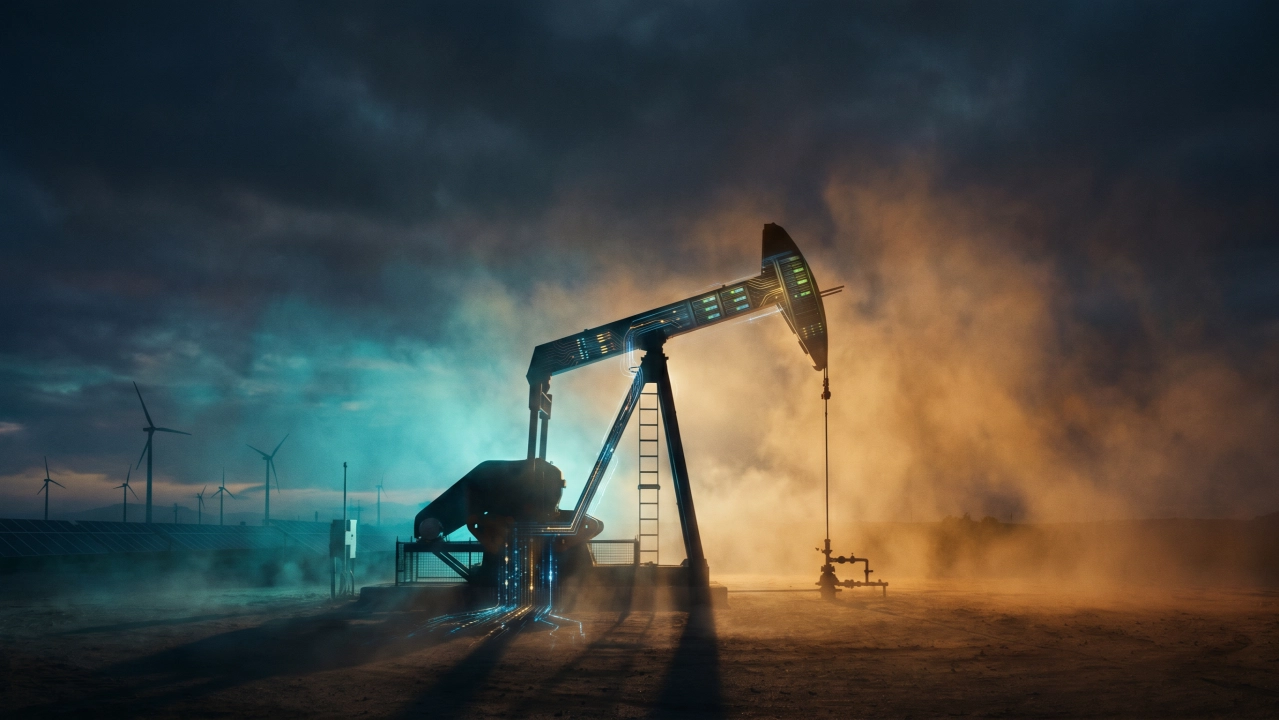
Every era has a commodity that decides who wins. In the twentieth century, it was oil. Whoever pumped it cheapest, shipped it fastest, and burned it most efficiently set the terms of the global economy. Oil didn’t just move cars. It moved geopolitics.
The commodity of this era is the token.
A token is the smallest unit of thought inside an AI model. Roughly three-quarters of a word. Every question you ask is turned into input tokens. Every answer the model gives back is output tokens. When an AI assistant reads a contract, drafts an email, or walks through a hundred-step task on your behalf, it is burning tokens the whole way.
Training a model is a one-time expense. Tokens are the recurring bill. And like a barrel of oil, the price per token decides which businesses are viable and which ones quietly go bankrupt.
Right now, the United States is losing the token price war. Badly. And almost nobody outside the builders has noticed.
The Two Americas of AI
Walk into any Silicon Valley office and ask which AI they use. You’ll hear ChatGPT. Claude. Maybe Gemini. That is the surface story. It is mostly about chat windows and monthly subscriptions, the consumer face of AI.
Now look one layer down, where actual applications get built. When a startup, a bank, or a retailer wires AI into their product, they are making API calls in the background. That is the real engine of the AI economy. And that engine is increasingly running on Chinese fuel.
On OpenRouter, the largest independent marketplace where developers pick which model to call, Chinese models captured 61% of total usage in February 2026. Four of the top five models worldwide now come from China: MiniMax, Kimi, GLM, and DeepSeek. Andreessen Horowitz estimates that roughly 80% of open-source AI stacks in the U.S. now run on Chinese models.
That isn’t a rounding error. That is the foundation of the application layer shifting under our feet.
The reason is not ideology. It is arithmetic.
The 10–20x Price Gap
Here is what a developer sees when they compare pricing today:
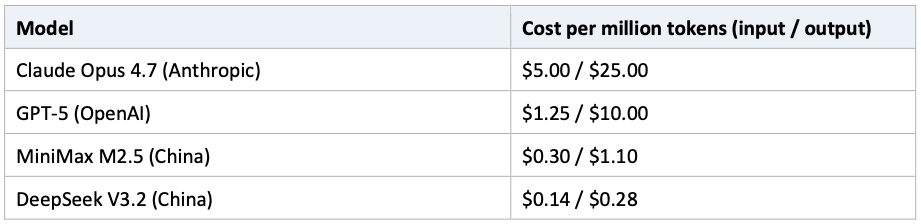
Sources: Anthropic, OpenAI, DeepSeek, Clarifai.
And the quality gap is far smaller than the price gap. MiniMax scores within a hair of Claude Opus on industry coding benchmarks. Moonshot’s Kimi K2 beats GPT-5 on several key reasoning tests. Near-equivalent intelligence, 10 to 20 times cheaper.
A founder running an AI product that consumes a billion tokens a month pays roughly $30,000 on Claude Opus. On MiniMax, about $1,400. That is the difference between a business and a money pit. I see a lot of frontier AI products and most quietly chose the cheapest fuel.
And they are routing. More than half of all tokens on OpenRouter now go to programming and agent tasks — exactly the workloads where cost compounds with every step. Exactly where Chinese models are winning.
How We Got Outflanked
The price gap didn’t come from a secret algorithm. It came from sanctions.
When Washington cut off China’s access to Nvidia’s best chips, Chinese labs had two options: give up, or learn to do more with less. They chose the second, and the results are now reshaping the industry.
DeepSeek trained a model competitive with the Western frontier on old, deliberately crippled chips for under $6 million. Meta’s comparable model used roughly eleven times as much compute. The Chinese teams did it by rethinking the model’s architecture so that only the relevant parts “wake up” for each question, by using a more compressed number format that runs twice as fast, and by writing custom low-level code that squeezed every last bit of performance out of weaker hardware.
Think of it like a car engine. American labs built a bigger engine. Chinese labs, denied access to premium parts, redesigned the engine itself to get more miles per gallon. Both approaches work. But one produces a commodity at half the price.
This is the oldest pattern in industrial history. When postwar Japan was shut out of American steel, they invented lean manufacturing. When European carmakers faced expensive fuel, they built high-efficiency engines that the U.S. is still catching up to. Constraints don’t stop innovation. They redirect it.
We tried to slow Chinese AI down. We taught it to be cheap instead.
The Other Half: Electricity
Efficient algorithms are only half the token cost equation. The other half is the electricity that runs the servers.
A single AI task can use up to a thousand times more electricity than a regular web search. Data centers drove half of all U.S. electricity demand growth in 2025. Every token served carries the cost of the kilowatt-hour that made it possible. And American electricity is getting more expensive fast.
Residential rates hit 17.45¢/kWh in January 2026, up 9.5% in one year. In California, that number is double plus. Utilities asked for $31 billion in rate hikes in 2025 — more than double the year before. Morgan Stanley projects a 44-gigawatt data-center power shortfall within three years. Gartner expects 40% of AI data centers to be power-constrained by 2027.
Meanwhile in China, data centers pay less than half the electricity rate that American data centers pay. New projects break ground in months, not years. China installed 315 gigawatts of solar in 2025 alone — more than America’s entire installed base, in a single year. They spent $818 billion on energy transition in 2024, more than the U.S. and Europe combined.
Cheap electrons plus cheap algorithms equal cheap tokens. That isn’t mysterious. That is a simple P&L.
The Self-Inflicted Wound
The part of this that should be a national scandal is that we have a cheap power option. We sold it for campaign cash.
Solar and wind, paired with batteries, are the cheapest new electricity an American utility can build. In much of the country they are already cheaper than natural gas. They go up in 18 months, not the 5 to 10 years a new gas plant takes. They were finally scaling, pulled forward by the $282 billion in private investment the Inflation Reduction Act unlocked in its first year alone. Most of that money flowed to Republican districts.
Then the check cleared.
The fossil fuel industry spent $445 million on the 2024 election. Trump asked oil and gas executives to raise him a billion dollars in exchange for their policy wish list. He won. The One Big Beautiful Bill Act handed oil and gas $18 billion in new tax breaks and gutted the credits that made clean power cheap. On July 4, the last window for solar and wind developers to qualify for federal tax credits slams shut. I wrote about this recently. The administration is now paying nearly a billion dollars to cancel offshore wind leases and moving to repeal the federal rule that lets the government limit air pollution at all.
The voters who handed the oil lobby this policy victory will pay for it on their electric bills. The American AI industry will pay for it in massive lost revenues.
Why This Compounds
Token economics is not a one-shot game. It is a flywheel.
Cheaper tokens make more applications viable. More applications generate more usage. More usage funds more research. Better models at lower prices pull in more of the developer ecosystem. Whoever anchors the application layer anchors the next decade. This is how AWS won cloud. This is how Android ate global mobile. The flagship brand doesn’t matter if the software everyone actually ships runs on someone else’s pipes.
Right now, the U.S. has the best-known AI brands. China has the application layer. And the application layer is where the economy will actually be rebuilt.
What Has to Happen
This is fixable. But not on a 2028 timeline.
- Treat electricity as infrastructure, not a political trophy. Restore the clean energy tax credits. Fix the permitting and transmission rules that keep projects sitting in line for years. Every month a solar-plus-storage project waits, the token price gap widens.
- Build nuclear like we mean it. The ADVANCE Act is already bipartisan. Small modular reactors next to data centers are a real answer. Stop treating them like a 2035 problem while the Koreans and Chinese break ground today.
- Let AI companies build their own power. Let hyperscalers put solar, wind, batteries, and gas directly at their data center campuses. Make permitting near-instant for projects that meet clean energy thresholds. Skip the grid queue entirely.
- Fund efficient AI research the way China funded it by accident. Our labs will chase scale because their investors demand it. The federal government should fund the thriftier frontier nobody else will — smaller, smarter, cheaper models.
- Make cost-per-token a board-level metric. If American AI companies are routinely five to ten times above the global benchmark on what it costs to serve a token, the frontier brand premium won’t hold forever. Investors are starting to ask. Founders already know.
- Stop taking energy advice from the people who profit when energy stays expensive. This is the part neither party wants to say out loud. Fossil fuel incumbents have every reason to keep the grid tied to commodities they control. A grid powered by sun and wind — where the fuel is free — is an existential threat to their business model. Campaign checks are, correctly understood, the defense budget of a dying industry. Dressing it up as energy security is a story. Cheap, clean, domestic power is actual energy security.
The Bottom Line
Oil built the twentieth century. Whoever controlled the barrel, the refinery, and the tanker set the terms. We understood that. We built a Navy around it.
Tokens are the new oil. The barrel is the model. The refinery is the data center. The tanker is the API. And the fuel beneath all of it is electricity.
Right now, China is producing tokens at roughly a tenth of what it costs in the United States — a gap made of algorithms our own sanctions forced them to invent, and electricity policy we chose not to adopt. Our frontier brands are still the most admired. Our application layer is being quietly rebuilt on someone else’s rails. And our government, paid by an industry that will not exist at its current size in twenty years, is handing the winner a multi-decade head start.
We have the talent. We have the capital. We have the labs. What we don’t have is time.
Every token served on an American server running expensive electricity is another reason the next generation of founders will quietly point their app at a Chinese endpoint and keep shipping.
The race is still winnable. But only if the country decides, quickly, that cheap electrons and efficient software matter more than campaign checks. Everything else is downstream of that choice.
Information provided by Mavka Capital. Securities are offered through Finalis Securities LLC, a member of FINRA/SIPC. Mavka Capital and Finalis Securities LLC are separate, unaffiliated entities. The views and opinions expressed in this article are those of the author and do not necessarily reflect the views or opinions of Finalis Securities, LLC.
The information contained in this message does not constitute legal advice and should not be considered an offer to purchase or a solicitation to sell securities or any other financial instruments; it is for informational purposes only.


