


On April 1, 2026, SpaceX confidentially filed its S-1 with the SEC. Codenamed Project Apex, the offering targets a valuation of $1.75 trillion and aims to raise up to $75 billion. If completed at that scale, it would surpass Saudi Aramco’s $25.6 billion IPO in 2019 by nearly three times. Days after the filing, Bloomberg reported SpaceX was already floating a $2 trillion figure to prospective investors.
Those are extraordinary numbers. But they are not irrational. They are the first clear evidence that a new variable has entered the valuation equation—and that the financial industry does not yet have a framework for it.
I am calling it Social Gravity.
The SpaceX Paradox
Start with the math. SpaceX generated roughly $15 to $16 billion in revenue in 2025 and about $8 billion in EBITDA. Starlink alone accounted for over $10 billion of that revenue, serving roughly 9.2 million subscribers by year-end and crossing 10 million by February 2026. The company completed 170 launches in 2025, including 165 Falcon 9 missions and five Starship test flights. These are real numbers from a real, operating business.
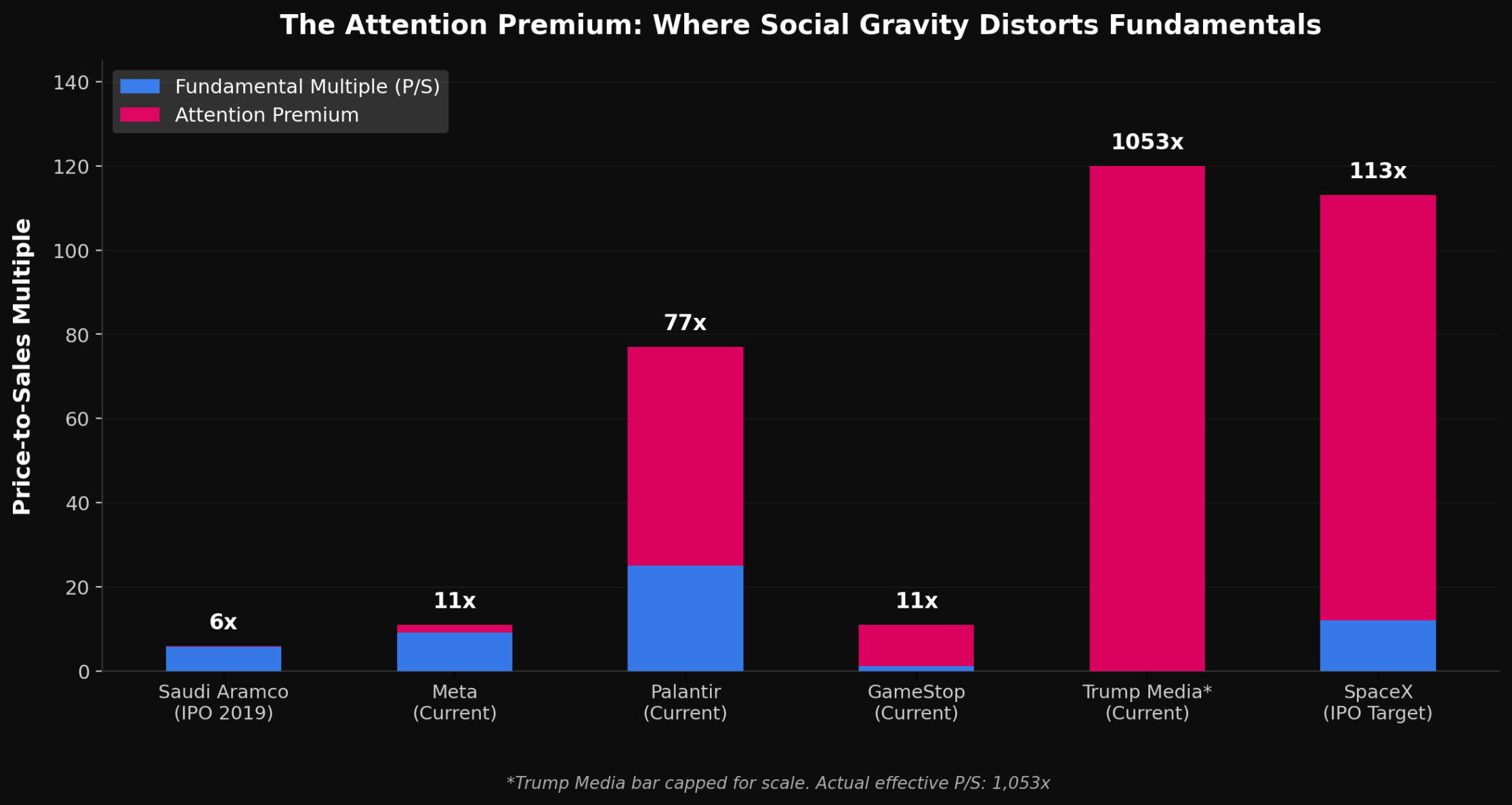
At a $1.75 trillion valuation, though, investors are paying a trailing price-to-sales multiple north of 100x. For reference, Palantir currently holds the highest P/S in the S&P 500 at roughly 77x. PitchBook projects SpaceX revenue could reach $150 billion by 2040, which would compress that multiple down to around 12x. But that projection is 14 years away.
No traditional model justifies paying 100x trailing revenue for a hardware-heavy company, no matter how impressive the growth. DCF models struggle because SpaceX’s cash flows are deeply reinvested and its terminal value assumptions span decades. Comparable analysis fails because there is nothing comparable. Sum-of-the-parts gets you closer, as PitchBook’s Franco Granda argued, but only if you grant what he calls a “platform premium” for the integrated ecosystem.
That platform premium is real. But it is not purely financial. It is social.
The Variable Nobody Models
Elon Musk has over 233 million followers on X. That is more than Barack Obama, more than Cristiano Ronaldo, more than every other CEO on the planet combined. The second-most-followed CEO, Tim Cook, has roughly 15 million.
That asymmetry matters—and not in the soft, brand-awareness way that marketers usually talk about.
SpaceX is proposing to allocate up to 30% of its IPO to retail investors. The typical number is 5 to 10%. This is not symbolic. It is a structural bet that the largest individual audience in the history of capital markets will show up as buyers and hold. Bank of America is coordinating U.S. retail distribution. Morgan Stanley’s E*Trade will handle smaller retail participants. The strategy mirrors what Musk observed at Tesla: retail believers hold longer than institutions.
There is no line item for “233 million followers” in a DCF. There is no comparables table that adjusts for a founder’s audience. But when you are raising $75 billion and allocating a third of it to individual investors who will show up because of a social media relationship with the founder, that audience is not a marketing asset. It is a capital formation engine.
Meme Stocks Were the Proof of Concept
We should have seen this coming.
In January 2021, GameStop went from $17 to $483 per share in less than a month. Hedge funds lost over $1 billion in a single day. A research paper published in Management Science confirmed what everyone watched happen in real time: social media discussions on Reddit, StockTwits, and X fueled the association between retail trading and price movement, distorting market quality for the stocks and their competitors.
Four years later, GameStop still trades at roughly a $10 billion market cap on under $1 billion in annual revenue. The company now holds $8.7 billion in cash and 4,710 Bitcoin. It issued $4.2 billion in zero-coupon convertible notes in 2025. The meme community did not just pump a stock; it fundamentally recapitalized a dying retailer.
In May 2024, a single post from Keith Gill on X sent GameStop surging 73% in pre-market trading. One person. One post. Billions in market cap movement. AMC jumped 31% the same week. AMC used a prior surge to raise $250 million directly off social media-driven demand.
Then there is Trump Media. DJT reported full-year 2025 revenue of $3.7 million and a net loss of $712 million. Its market cap has floated between $2.5 billion and $10 billion depending on the political cycle. At its peak, JPMorgan estimated Truth Social was valued at $1,000 per registered user, compared to Meta’s $408 per user, Reddit’s $147, and Snapchat’s $46.
That is not simply irrational pricing. It is pricing a different asset. Trump Media investors are not buying a social media platform. They are buying an identity position. The “quasi-religious fervor,” as Interactive Brokers’ Steve Sosnick put it, is the product.
Consider Destiny Tech100. The closed-end fund holds roughly $53 million in private company shares and traded at a 2,000% premium to its net asset value shortly after its NYSE debut. Investors were paying $20 for every $1 of underlying assets. As Morningstar noted, mutual funds at Fidelity and Baron Capital hold SpaceX at the same marks. But they do not trade at a 900% premium. The difference is meme energy. Destiny Tech100 had a narrative. The mutual funds did not.
What These Data Points Have in Common
The throughline is not mere speculation. It is not even primarily irrationality. It is a measurable, repeatable pattern: social media engagement creates sustained demand for equity that traditional models cannot price.
A 2021 study in Economics Letters found that meme periods show “persistent price and volume effects tied to social media buzz.” A Claremont McKenna College thesis using fixed-effects panel data models found that WallStreetBets mentions and Robinhood user activity are positively associated with both closing price and trading volume. A paper at Notre Dame demonstrated that retail investor attention can predict market wide performance.
And a 2025 thesis in Management Science and Economics quantified what practitioners already knew: CAPM systematically fails to capture the pricing behavior of meme stocks. Jensen’s Alpha, the standard measure of abnormal return, spikes in direct correlation with cross-sectional return dispersion driven by herding behavior on social platforms.
This is not noise. It is signal. And it needs a model.
Introducing Social Gravity Valuation
Traditional valuation asks: What are the expected future cash flows of this business, discounted to present value?
Social Gravity Valuation adds a second question: What is the sustained demand premium created by a company’s ability to attract and retain attention as a capital formation mechanism?
Here is the framework.
The Three Components
1. Attention Capital (AC)
Attention Capital measures the scale and quality of a company’s audience as potential equity demand. This is not simply impressions or reach. It is the measurable pool of individuals who have a relationship with the brand, founder, or community that makes them structurally likely to buy and hold equity.
Inputs:
- Founder/CEO direct social following (weighted by platform and engagement rate)
- Dedicated community size (subreddit members, Discord servers, StockTwits followers)
- Search volume trends (Google Trends data for the ticker and company name)
- Retail brokerage penetration (percentage of retail accounts holding the stock)
SpaceX’s Attention Capital is historically unprecedented in public markets. Musk’s 233 million followers represent the largest founder-audience relationship ever brought to a public offering. That audience is not passive. They have already demonstrated capital commitment through Tesla, which built one of the most dedicated retail shareholder bases in equities.
2. Narrative Durability (ND)
Not all attention is equal. A viral moment creates a spike. A durable narrative creates a floor.
Narrative Durability measures how long social media-driven demand persists after the initial catalyst. GameStop is the archetype here. Four years after the squeeze, the stock still trades at 10x its fundamental value. That is not a classic bubble. Bubbles pop. This is a community that recapitalized a company through sheer conviction.
Inputs:
- Holding period data (average retail position duration vs. institutional)
- Price floor analysis (lowest price achieved after each social media catalyst)
- Community activity persistence (sustained engagement metrics over 6 to 12 month windows)
- Capital raises completed during elevated social demand (ATM offerings, convertible notes)
3. Conversion Efficiency (CE)
The final variable measures how effectively social attention converts into actual capital flows. Trump Media demonstrates high Attention Capital (110 million followers for Donald Trump on X) but relatively low Conversion Efficiency. The company raised limited capital from its social audience relative to its market cap. GameStop, by contrast, demonstrated extraordinary Conversion Efficiency, issuing $4.2 billion in notes directly to a community that actively sought to own more of the company.
SpaceX’s proposed 30% retail allocation is an explicit attempt to maximize Conversion Efficiency. The infrastructure is being built into the offering itself.
Inputs:
- IPO/secondary retail allocation as percentage of total offering
- Retail volume as percentage of total trading volume
- Direct-to-retail capital raise history (if any)
- Social media-to-brokerage funnel data (where available through platforms like Robinhood or E*Trade)
The Formula
The Social Gravity Multiple is calculated as:
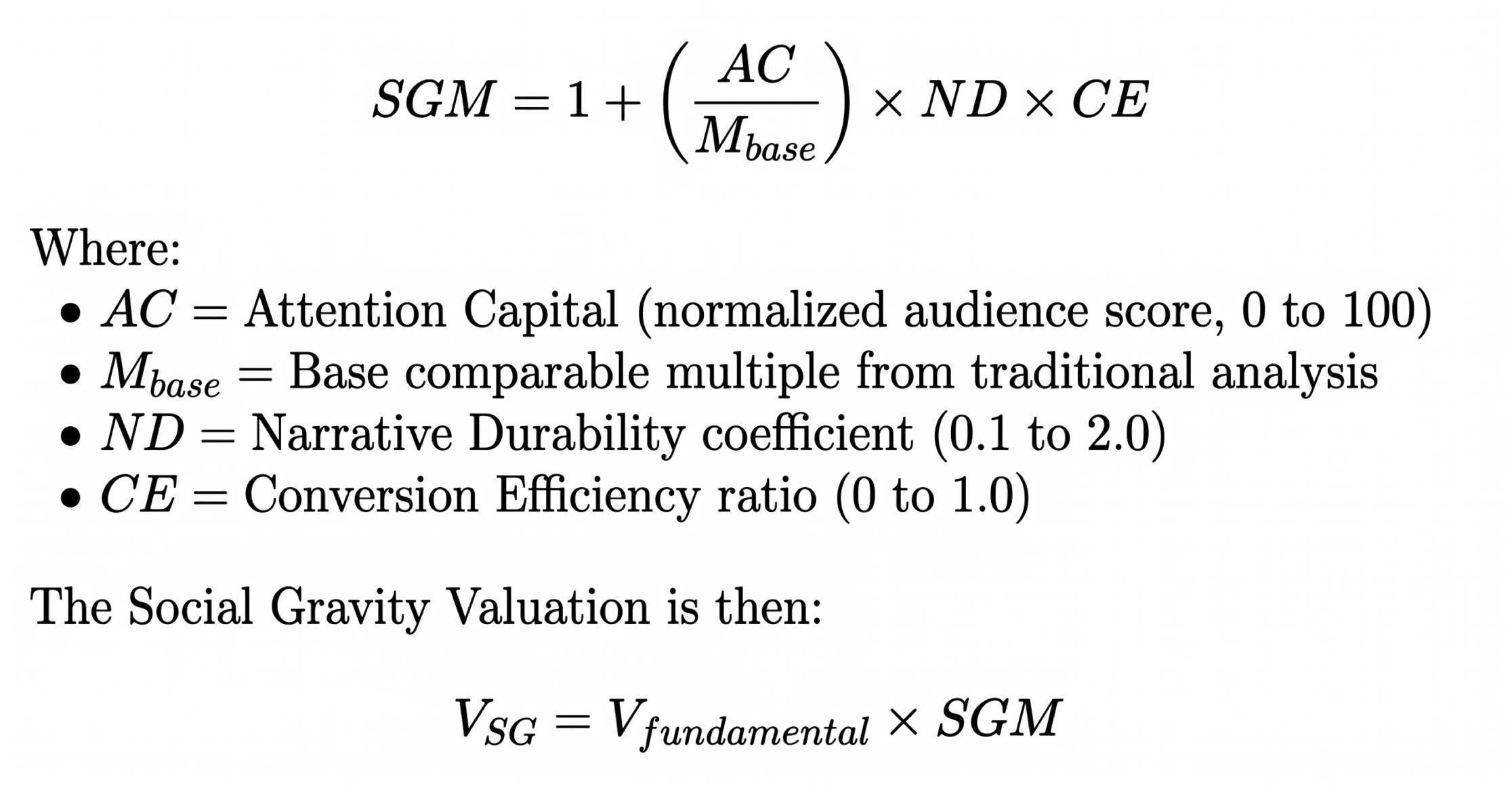
This is not a replacement for fundamental analysis. It is a multiplier on top of it. A company with zero social gravity would have an SGM of 1.0 and would be valued purely on fundamentals. A company like SpaceX, with maximum attention capital, proven narrative durability (via Tesla’s track record), and an offering structure designed for high conversion efficiency, could carry an SGM in the range of 3x to 8x above its fundamental base.
Applying the Model
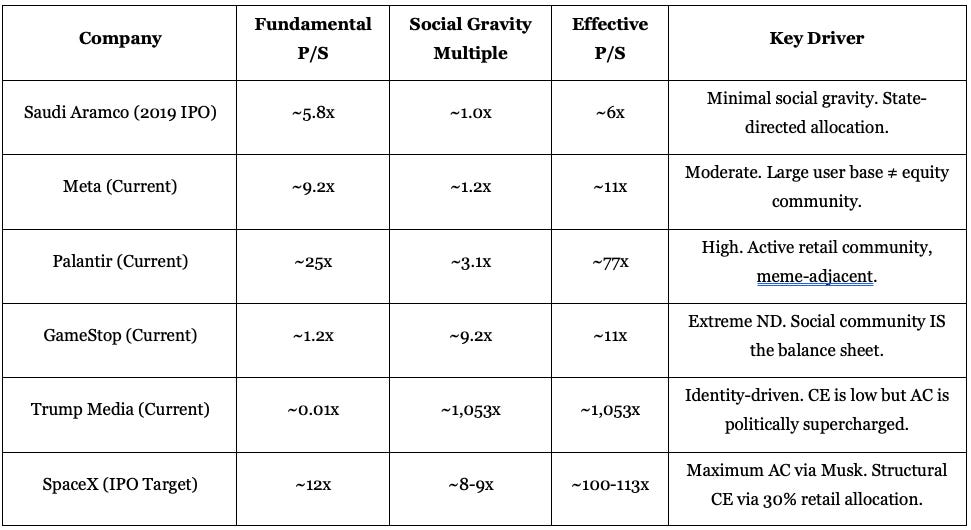
The model does not attempt to predict price. It tries to explain the gap between what fundamentals justify and what the market actually pays, and gives that gap a structured, measurable framework rather than dismissing it as “irrational exuberance.”
Why This Matters Now
The SpaceX IPO is the inflection point. It is the first time a company has explicitly designed an offering to harvest Social Gravity. The 30% retail allocation is not a PR stunt. It is a capital markets innovation. It says: we know our audience is our most durable source of demand, and we are building the pipes to convert that audience into shareholders.
This will get copied. OpenAI and Anthropic are both reportedly weighing IPOs before year-end. Every one of them will study the SpaceX playbook and ask: How do we build our own Social Gravity before we go public?
NASDAQ has already issued rule changes that could allow SpaceX to join the NASDAQ 100 within 15 days of listing, which would trigger billions in forced buying from index-tracking funds. The social demand converts to retail ownership, which triggers index inclusion, which triggers institutional demand. That is a flywheel. And it starts with followers.
Harvard Law published a paper arguing that the DCF methodology is fundamentally untestable. There is no evidence it predicts market value for businesses and common stocks. We have been using a model built for a world where capital was allocated by institutions reading 10-Ks. That world is shrinking. The new world has 233 million people who will watch a rocket launch on their phones and then open E*Trade.
The Implication for Founders
If you are building a company and your only valuation strategy is financial performance, you are playing an incomplete game.
Social Gravity is not about being a meme. It is about building a direct relationship with the people who will eventually buy your stock. The founder who has 500,000 engaged followers on X, a subreddit of 50,000, and a newsletter with a 40% open rate has more capital formation optionality than the founder with identical revenue and zero audience.
VCs should be modeling this. Investment bankers should be pricing it. And founders should be building it years before they ever think about going public.
The moat used to be about keeping competitors out.
Social Gravity is about pulling capital in.
Information provided by Mavka Capital. Securities are offered through Finalis Securities LLC, a member of FINRA/SIPC. Mavka Capital and Finalis Securities LLC are separate, unaffiliated entities. The information contained in this opinion piece does not constitute legal advice and should not be considered an offer to purchase or a solicitation to sell securities or any other financial instruments; it is for informational purposes only.


