


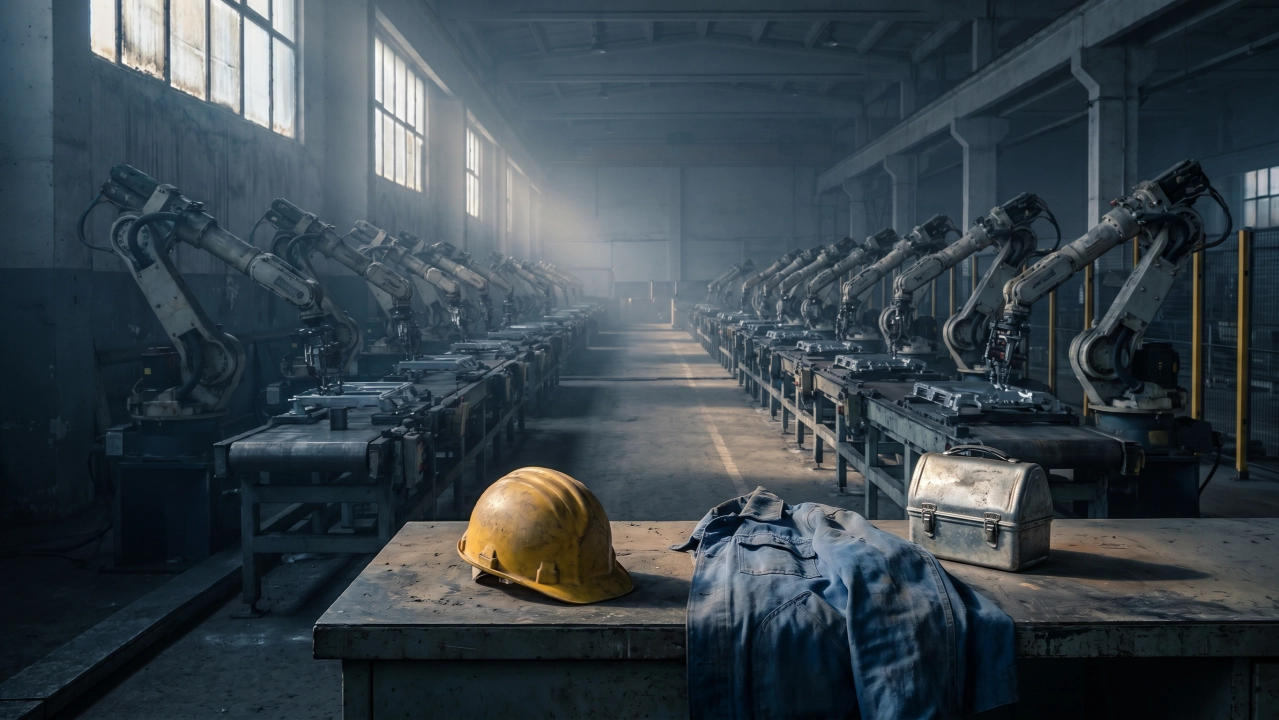
Every industrial revolution rewrites the social contract. The only question worth asking is how much time the people living through it get to rewrite their own lives.
The first one ran roughly a century. Steam, coal, and the factory system pulled people off farms and into cities between 1760 and the late 1800s. A boy born to a weaver in 1780 still apprenticed under his father. His grandson worked a power loom. Three generations to absorb the shock. Trade unions formed, public schools were invented, child labor laws were passed, and a whole new middle class came into being on the back of factory work.
The second, electricity and mass production, ran roughly fifty years. Edison’s grid to Ford’s line to the postwar consumer economy. Two generations. Long enough to build the suburbs, the highway system, the union contract, Social Security, and the GI Bill.
The third, computing and the internet, ran about forty years. Mainframes, PCs, web, mobile. One generation. Painful in places, transformative in others. The Rust Belt never came back. But software ate the world, and the world had time, just barely, to grow the kinds of jobs that absorbed the people software displaced.
This one will run in less than ten.
That is the entire argument. Everything else is detail.
The Speed Problem in One Chart
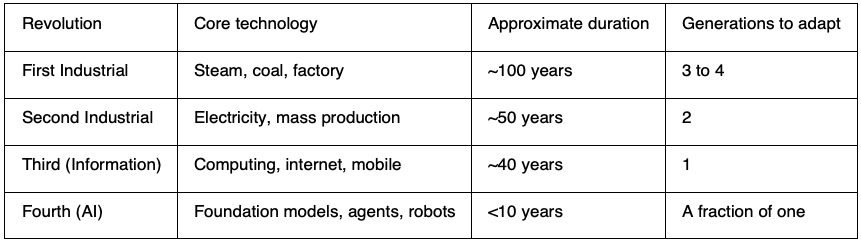
In every previous wave, the technology moved slower than the human systems that needed to adapt to it. Workers could retrain for jobs that existed. Communities could attract replacement industries. Schools could update curricula. Governments could pass laws. That gap is what made adaptation possible.
AI moves faster than human systems can adapt. That is the change. That is the only change that matters.
What “Faster” Actually Looks Like
Numbers from operating businesses, not forecasts.
Amazon’s internal documents, leaked to the New York Times in October 2025, show the company plans to avoid hiring 160,000 workers it would otherwise need by 2027 and 600,000 by 2033, with an internal target to automate 75 percent of its operations.
The six largest US banks, JPMorgan, Citi, Bank of America, Goldman Sachs, Morgan Stanley, and Wells Fargo, reported $47 billion in first-quarter 2026 profits, up 18 percent from a year earlier, while their combined headcount fell by roughly 15,000. Bank of America’s chief executive told investors that AI tools had eliminated about 1,000 positions through attrition.
Anthropic’s Dario Amodei, who is not exactly a doomer, told Axios that AI could eliminate roughly half of all entry-level white-collar jobs within five years and push US unemployment to between 10 and 20 percent.
Goldman Sachs’s economists, in their base case, estimate that 6 to 7 percent of the US workforce will be displaced over a ten-year transition, with unemployment rising about half a percentage point. They call it “frictional.” A more recent Goldman update finds AI has already reduced US payroll growth by roughly 16,000 jobs per month and lifted the unemployment rate by 0.1 percentage points. Frictional is a word people use when they are looking at a spreadsheet, not at a fifty-two-year-old logistics coordinator who just got an “Operational Enhancement Initiative” email.
The IMF, in an August 2025 staff paper, found that roughly one fifth of the Danish workforce, and about a quarter of its private-sector workforce, is highly exposed to generative AI. Denmark has one of the most sophisticated labor-market transition systems on Earth. If a quarter of the Danish private sector is at risk, what is the number for the manufacturing town in Ohio with a community college that last updated its curriculum in 2019?
Two-year retraining programs are the wrong instrument for a market that re-shapes itself every six months. The worker who enrolled in a logistics management certificate in 2024 is graduating into a market that no longer needs logistics managers. The committee in Washington that started drafting a workforce policy eighteen months ago will deliver it into a labor market that has already moved twice.
The honest version of “we’ll just retrain everyone” is that nobody has ever retrained at this speed and at this scale. Not in the New Deal. Not in the postwar boom. Not in any of the famous transition stories the consultants like to cite.
What History Says Happens When You Can’t
Modern economies are not designed to run for long at unemployment levels above roughly 10 percent. When they do, the political system stops behaving like the textbook says it should. The pattern is one of the most reliable findings in twentieth-century political science, and the historical record fits in a single page.
Weimar Germany, 1930 to 1933. German unemployment rose from 8.5 percent in 1929 to roughly 30 percent by 1932. Over six million people were out of work. The Nazi share of the vote went from 18.3 percent in 1930 to 37.3 percent in July 1932 to 43.9 percent in March 1933. Combined totalitarian parties, Nazis plus Communists, crossed 57 percent in mid-1932. A statistical study by Bruno Frey and Hannelore Weck-Hannemann found that each one-percentage-point rise in unemployment increased the Nazi vote share by roughly half a percentage point, and that without the rise in unemployment the NSDAP vote in 1933 would have been closer to 23 percent than to 44 percent. There is no version of that history in which Hitler comes to power without the Depression.
United States, the same period. Unemployment hit 24.9 percent in 1933. Twelve million people out of work. What pulled the country back was not market self-correction. It was a Manhattan Project of policy, the New Deal, deployed in months, not years. Banking reform, public works, deposit insurance, unemployment insurance, Social Security, the Wagner Act. American history at 25 percent unemployment looks different from German history at the same number because the institutional response was massive. The alternative was on the table.
Spain, 1936. Mass unemployment, regional collapse, and a political system that could no longer absorb the pressure produced a civil war that killed roughly half a million people and installed a fascist dictatorship for nearly four decades.
Argentina, 2001 to 2002. Unemployment crossed 18 percent in 2001 and reached 23.6 percent in 2002. The country went through five presidents in ten days, defaulted on $93 billion in sovereign debt, and saw bank deposits frozen by decree. Two decades later Argentine politics still has not recovered the institutional trust that crisis destroyed.
Greece, 2012 to 2013. Unemployment hit 28 percent. Youth unemployment hit 62 percent. Golden Dawn, an openly neo-Nazi party that had taken 0.29 percent of the vote in 2009, jumped to 7 percent in 2012. The two traditional governing parties, which had averaged 84 percent of the vote across ten elections from 1981 to 2009, collapsed to 32 percent in May 2012. A democracy that had been stable since 1974 became, briefly, a place where elected legislators were assaulting opponents on live television.
The Arab world, 2011. Tunisian youth unemployment was running at roughly 42 percent, Egyptian youth unemployment around 38 percent. A street vendor named Mohamed Bouazizi, unable to find work and harassed by police, set himself on fire. Within eighteen months, four governments had fallen.
The pattern across these episodes is consistent enough to legislate around.
- Below 10 percent unemployment, democracies are stressed but stable.
- Between 10 and 20 percent, mainstream parties lose ground rapidly. Anti-system movements take vote share that was unimaginable five years earlier. Public trust in institutions craters. The window for centrist reform begins to close.
- Above 20 percent, the historical record contains revolutions, civil wars, sovereign defaults, and the rise of regimes that are still poisoning the politics of those countries today.
Anthropic’s chief executive has now stated, on the record, that AI could push US unemployment to 10 to 20 percent inside five years. That is not a forecast about technology. It is a forecast about which historical bracket the United States is about to enter. Anyone repeating “the market will create new jobs” without engaging with that range is not being optimistic. They are being unserious.
Why the Standard Reassurance Doesn’t Work This Time
The standard line runs like this. New technology has always created more jobs than it destroyed. Horses got replaced by cars and the auto industry employed millions. Bank tellers got replaced by ATMs and there are now more bank branches than ever. The Luddites were wrong. They will be wrong again.
The historical part is true. The conclusion is sloppy.
What previous transitions had, that this one does not, is time. Cars did not replace horses in three years. They replaced horses over four decades, during which the country built highways, gas stations, suburbs, drive-ins, motels, parts suppliers, mechanics, dealerships, insurance, and an entire visual culture around the automobile. The new jobs were not designed in advance. They emerged because the old system had time to grow new tissue around the wound.
AI does not give the system time to grow new tissue. It cuts faster than the wound can close.
There is a second problem. The “new jobs” the optimists like to point at are increasingly jobs that AI itself can do. Prompt engineering as a profession had a useful half-life of about eighteen months. Coding bootcamps that taught entry-level software engineering as the path out of displacement are graduating students into a market where AI agents are writing the entry-level code. The career ladder is being kicked away one rung at a time, faster than people can climb it.
The ladder is shorter than the slide deck says it is.
Agency and Community
Economic displacement is one variable. The political and social variables are the ones that decide whether a country gets through it.
A job is not just a paycheck. It is a place to be in the morning. It is a set of people who notice when you do not show up. It is a structure that organizes the week, supplies an identity to introduce at a barbecue, and gives a person somewhere to direct the basic human appetite for usefulness. Labor economists model the income loss. They do not model the structure loss, the identity loss, or the community loss, because those things do not appear in the unemployment rate.
The structure loss is already visible. Time-use surveys show a measurable collapse in friendship, civic participation, religious attendance, and household formation among non-college men. Companion-AI usage skews heavily young and male. Common Sense Media reports that more than half of Character.AI‘s roughly twenty million monthly users are under twenty-four, and an industry survey found that 19 percent of US adults, and 31 percent of young men, have chatted with an AI romantic partner. The same industry that is automating their jobs is selling them substitute relationships, on subscription, optimized for retention.
The pattern compounds. A man loses his job. He loses the daily structure. He loses the social contact that came with the job. He spends more time alone. The algorithm finds him. The grievance content finds him. The supplements and the crypto and the political entrepreneur find him. By the time anyone in Washington has finished a hearing on workforce transition, he has been monetized at five layers of the stack and he is voting for whoever shouts the loudest about who took his country away.
That pipeline is the central political fact of our time, and it is going to get dramatically worse over the next five years if it is not legislated against.
Economic Guardrails
Mass technological unemployment is a textbook externality. The company captures the productivity gain. The community absorbs the social cost. The government picks up the bill, eventually, in the form of disability claims, opioid epidemics, school district collapse, and the political instability that arrives a decade later.
This one can be priced. The short version of what that looks like:
A displacement levy on the companies actually doing the displacing. If a business model is to replace a category of human labor at scale, it should contribute, at a rate calibrated to the displacement, to a public transition fund. Not voluntary. Not a tax credit. A line item. The same principle is already applied to companies that pollute air or water. AI labor displacement is a measurable, attributable externality.
Portable benefits, decoupled from the job. Health care, retirement, disability, parental leave. None should be tied to a single employer in an economy where a worker will have eight employers and four career changes by sixty. Denmark figured this out decades ago.
A workforce transition system that operates on AI timelines, not committee timelines. Eighteen-month retraining programs into roles that may not exist when the cohort graduates are not a serious response. Short-cycle, modular, employer-co-designed programs that move a worker into a paying role within ninety days, with real income support during the gap. This is a procurement problem more than a philosophical one.
Direct restrictions on the use of AI as a pretext for layoffs. This is the one Americans will find most foreign. It deserves a longer look.
The China Example
While Washington argues, Beijing has already legislated.
In late April 2026, the Hangzhou Intermediate People’s Court ruled that a Chinese tech company had illegally fired a senior quality-assurance supervisor named Zhou after his role was automated by AI and he refused to accept a 40 percent pay cut to a different position. The court was explicit. AI adoption is a strategic business choice, not an unforeseeable change in objective circumstances. It does not meet the standard, under Article 40 of China’s Labour Contract Law, that would justify terminating an employment contract. The company was ordered to pay compensation.
This was not a one-off. Six months earlier a Beijing arbitration panel had ruled the same way in the case of Liu, a map data collector whose entire department was eliminated when his employer switched to AI-powered automated data collection. The Beijing Municipal Human Resources and Social Security Bureau then published the case in December 2025 as one of the ten most significant labor arbitration decisions of the year, which in Chinese administrative law signals to courts and companies across the country that this is now the line.
The principle the courts laid down: a company can adopt AI. It cannot use AI as a pretext to fire the people whose jobs it automates. If a role is automated, the worker has to be given another role at comparable terms, retrained, or paid. From the Hangzhou ruling: “Companies cannot unilaterally lay off employees or cut salaries due to technological progress.” The accompanying guidance: “Employers are prohibited from shifting operating costs to employees.”
That is what an economic guardrail looks like.
The argument is not that the United States should adopt the Chinese system wholesale. China is a one-party state with a labor regime built around social stability as a paramount political concern. The argument is that the United States, with no equivalent legal protection at all, has the worst possible posture for a country about to run a labor disruption at this speed. The European Union’s AI Act requires risk and impact assessments that include workplace use, and member-state labor codes already provide redundancy protections during automation-driven transitions. China has now established that AI cannot be used as legal cover for terminations. The United States has neither, and is also home to most of the companies driving the displacement. It is uniquely exposed and uniquely uninsured.
The American version of this principle does not have to be a Chinese-style mandate. It can look like a “duty to retrain or relocate” obligation written into employment law, triggered when a layoff is attributable to automation. It can look like an automation-specific WARN Act with a longer notice period and a funded transition obligation. It can look like a federal cause of action for workers wrongfully classified as redundant when their function has merely been re-tooled. The legislative form is negotiable. The principle is not. The cost of disrupting a worker’s livelihood should sit on the balance sheet of the entity that captured the gain, not the family that absorbed the loss.
What This Argument Is Not
It is not an argument to stop building AI. Much of what is being built represents genuine progress, including in domains like cancer research and clean energy where progress is morally urgent.
It is not an argument that the technology is the problem. The technology is the technology. It does what it is incentivized to do.
The argument is that the speed of this revolution, more than any prior one, is going to outrun the human systems built to absorb the last one. That “the market will create new jobs” is being repeated by people who have not looked at how short the new ladder is or how fast the floor is moving. That “just retrain” is, in 2026, a sentence finance ministers and senators use to sound responsible without committing to anything that costs money.
The political consequences of getting this wrong are not abstract. The historical record is on the table. Weimar, Spain, Argentina, Greece, the Arab world. The number that determines which of those stories the United States ends up living through is the unemployment rate during the transition years, and the only thing standing between those numbers and that outcome is policy designed and deployed on the same timeline as the technology.
The Bottom Line
Three industrial revolutions in a row gave societies enough time, just barely, to grow the new institutions the new economy required.
This one will not.
The companies are deploying now. The pitch decks are real. The operating decisions are real. The TAM slides describe real paychecks belonging to real people who do not yet know the transition has started. The retraining programs being pointed at are too slow. The political institutions designed to manage transitions are too slow. The philosophy inherited about how labor markets self-correct was written for a world where the machine moved slower than the workers.
That world is over.
Every country that has crossed 20 percent unemployment in the modern era has come out politically transformed and, in several cases, never recovered. China has drawn its line. Europe has drawn its line. The United States has, so far, drawn no line at all.
The talent is here. The capital is here. The labs are here. What is missing, and has always been missing, is the assumption that someone else’s livelihood is supposed to absorb the cost of someone else’s quarter.
That assumption needs to break before the labor market does. Or history will remind us, again, what it does to countries that let it run.
Information provided by Mavka Capital. Securities are offered through Finalis Securities LLC, a member of FINRA/SIPC. Mavka Capital and Finalis Securities LLC are separate, unaffiliated entities. The information contained in this opinion piece does not constitute legal advice and should not be considered an offer to purchase or a solicitation to sell securities or any other financial instruments; it is for informational purposes only


